
Health Tech and Care Platforms
Build Family and Caregiving Products Around What People Actually Need
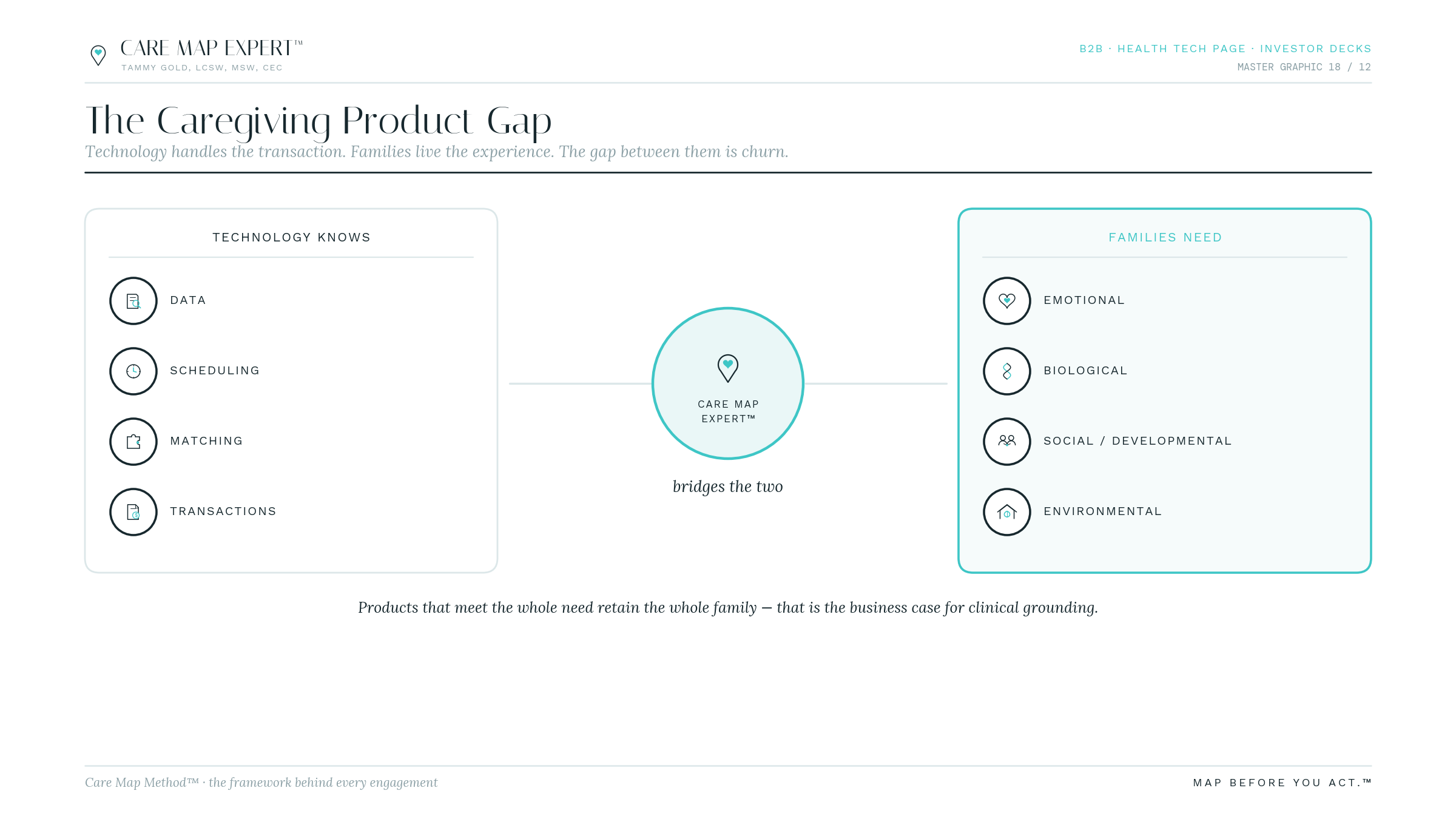
Technology teams understand product, data, matching and scheduling. Families experience biological, social, environmental and emotional needs, plus relationship dynamics. Care Map Expert is the bridge between the two.
Written for founders, product, clinical and member experience teams building caregiving, parenting, eldercare or family health products.
As featured in








What this looks like
Where family products lose people.
An intake that collects logistics but never surfaces what the family is actually deciding.
Matching logic tuned to availability and skills, with no read on fit, dynamics or household reality.
Content that is accurate and still unusable at the moment a family opens the app.
No escalation path when a member's situation moves from question to crisis.
Caregiver onboarding that ends at placement, so the arrangement is never merged into real life.
AI-generated guidance shipping without clinical review or guardrails.
Why information is not enough
Product logic and family reality are not the same model.
The gap is not engineering quality. It is that a family's needs are layered and competing, and a product has to encode judgment it was never given.
- Four domains, read together
- Biological, social, environmental and emotional needs do not arrive one at a time. A product that scores them separately gives advice that contradicts itself.
- Relationship dynamics
- Who decides, who resists, who pays and who is exhausted changes the right recommendation. Most data models have no field for that.
- Competing needs
- Safety against autonomy, cost against proximity, speed against fit. These are tradeoffs, and the product has to present them as tradeoffs.
- Language people trust
- The wording of a single screen decides whether a caregiver keeps going or closes the app. That is a clinical judgment, not a copy preference.
The process
From human need to shipped experience.
The bridge from human need to product logic.
- Human NeedDefine what the family is actually experiencing and deciding, in their own terms.
- Care MapTranslate that need into a Care Map: domains, stages, and the decisions in order.
- Product TranslationConvert the map into intake, segmentation, content architecture and workflow logic.
- ImplementationWork alongside product, clinical and content teams as it is built.
- ReviewClinically review language, flows and generated content before and after release.
View the full diagramHer original sheet, as supplied.
What Care Map Expert does
The work inside an engagement.
User personas and care journeys
Personas built on caregiving stage and household reality, with the journey each one actually travels.
Intake and needs assessments
Assessment instruments that surface the deciding factors, not just demographics and availability.
Content architecture
How guidance is organized by stage and domain so a member finds the right thing at the right moment.
Coaching and care-navigation workflows
The step logic behind a coached or navigated experience, including what happens between sessions.
Human escalation pathways
Where technology hands off to a person, on what signal, and what that person is expected to do.
Caregiver onboarding flows
Structured onboarding after a match, so the arrangement is merged into the household rather than dropped into it.
AI content guardrails and review
Prompt structures, boundaries and a clinical review loop for anything generated for families.
Expert content libraries
Educational libraries authored or reviewed by a credentialed caregiving expert.
Clinical review of language and experience
A pass over the words and the flow, screen by screen, for clinical and emotional appropriateness.
What you receive
What your team receives.
- User personas and care journeys
- Intake and needs assessment instruments
- A content architecture by stage and domain
- Coaching and care-navigation workflows
- Human escalation pathways
- Caregiver onboarding flows
- AI content guardrails and a review loop
- Expert content libraries
- Clinical review notes on language and experience
Proof
Credentials and press.
Tammy Gold, MSW, LCSW, CEC. Licensed Clinical Social Worker in California (#295160), New Jersey (#44SC05528100) and Oregon (#L16530). Twenty years of experience across parenting and child development, childcare and nannies, senior and eldercare transitions, and family life transitions. Author and creator of the Care Map Method.
Consulting, advisory and training work does not create a therapist–client relationship with your organization or its employees, and is not psychotherapy.
Questions buyers ask
Before you inquire.
Any stage where the family experience is being defined or rebuilt: pre-launch design, a caregiving feature inside a larger platform, or a member experience that is not landing.
Alongside it. Care Map Expert brings caregiving and family-systems judgment across the lifespan and hands it to your team in a form product can build.
Yes. That includes prompt structure, guardrails, escalation triggers and a clinical review pass on generated guidance.
No. The engagement is with your company. It does not create a therapist–client relationship with your members and is not psychotherapy.
After a conversation about your product, your users and the decision you are trying to support. Scope follows the question in front of you.
Health Tech and Care Platforms
Families do not experience features. They experience a decision they cannot postpone.
Discuss a care platform partnership.
Send what you are building, who it serves and where the family experience is breaking down. You will receive a reply with next steps.
Related
- Clinical and Expert Advisory
Standing clinical judgment at the strategy table.
- Content and IP Licensing
License Care Maps, assessments and decision trees into your product.
- Staffing and Caregiver Training
Turn placement into a managed care system.
- The Care Map Method
The framework the product translation is built on.