
Clinical and Expert Advisory
Put a Caregiving Expert at the Strategy Table
Decisions about caregiving products, benefits and care models get made in rooms without a clinician in them. Care Map Expert brings twenty years of family and caregiving judgment into those rooms, from one consultation to a standing advisory role.
Written for founders, healthcare and care companies, and investors evaluating or building family and caregiving offerings.
As featured in








What this looks like
The questions that stall a strategy meeting.
Every one of these is a clinical judgment being made by a team without one.
Are we addressing the right caregiver needs?
What should our assessment ask?
How should users be segmented across caregiving stages?
Is our language clinically and emotionally appropriate?
What happens before, during and after a caregiving crisis?
Where should technology hand off to human support?
Why information is not enough
Market research tells you demand. It does not tell you judgment.
The hard parts of a caregiving strategy are the tradeoffs. Those get resolved by experience with families, not by a survey.
- The need behind the request
- What caregivers ask for and what resolves their situation are often different things. Building the first one produces usage without relief.
- Segmentation that matches reality
- Caregiving stage, household composition and decision authority segment a population far better than age or diagnosis.
- Crisis sequencing
- Before, during and after a caregiving event require different products, different language and different handoffs. Most roadmaps only build for during.
- Where the human belongs
- Deciding what technology should not attempt is the most valuable line in a care model, and the easiest one to draw too late.
The process
How advisory work runs.
The engagement ladder: consultation, project, retainer, advisory board.
- AssessReview the model, the assessment, the language and the care pathway as they stand today.
- AdviseBring clinical and family-systems judgment to the open strategic questions.
- DevelopBuild what is missing: assessment content, segmentation logic, pathways, guardrails.
- ReviewReview language, experience and generated content for clinical and emotional appropriateness.
- EmbedContinue as a standing expert voice through a retainer or advisory board seat.
View the full diagramHer original sheet, as supplied.
What Care Map Expert does
Four ways to engage.
Engagements scale from a single question to a standing seat.
One-time consultation
A focused session on a specific decision: an assessment, a care pathway, a positioning question.
Defined project
A scoped piece of work with a deliverable: segmentation model, assessment instrument, escalation pathway, clinical language review.
Ongoing retainer
Recurring availability for product, clinical and content questions as they arise, with regular review cycles.
Advisory board role
A named clinical and caregiving expert on your advisory board, contributing to strategy and diligence conversations.
The advisory hub
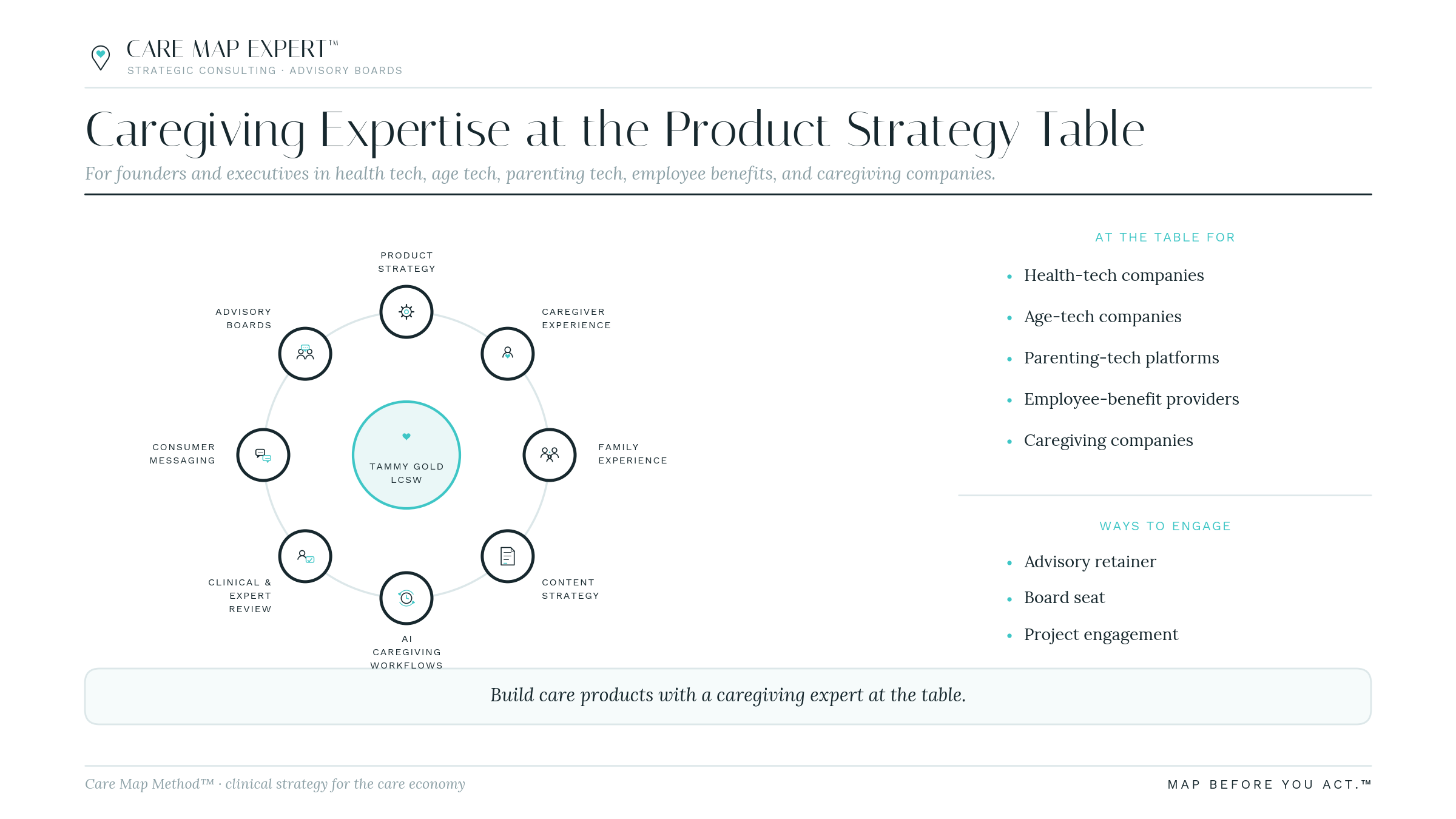
Caregiving expertise at the product strategy table.
Eight places a caregiving clinician changes a decision, and the three ways companies engage her to do it.
Advisory work is not a review at the end. It is a seat at the table while product strategy, caregiver and family experience, content strategy, AI caregiving workflows, clinical review and consumer messaging are still being decided, because that is when the cost of getting a caregiving assumption wrong is lowest.
Engagement takes three shapes: an advisory retainer for continuous input, a board seat, or a defined project when a single decision needs clinical grounding.
What you receive
What comes out of an engagement.
- A written review of your current care model
- Assessment content and question sets
- Segmentation logic across caregiving stages
- Before, during and after crisis pathways
- Technology-to-human handoff criteria
- Clinical language and experience review notes
- Standing availability under a retainer, where scoped
- A named expert voice for advisory and diligence conversations
Proof
Credentials and press.
Tammy Gold, MSW, LCSW, CEC. Licensed Clinical Social Worker in California (#295160), New Jersey (#44SC05528100) and Oregon (#L16530). Twenty years of experience across parenting and child development, childcare and nannies, senior and eldercare transitions, and family life transitions. Author and creator of the Care Map Method.
Consulting, advisory and training work does not create a therapist–client relationship with your organization or its employees, and is not psychotherapy.
Questions buyers ask
Before you inquire.
The questions you ask users, how you group them, the words on the screen, and where a person takes over from the product. Those four decisions shape most of the experience.
Yes. Many engagements begin as one consultation on a single question, then move to a project or retainer if the work continues.
Yes, on caregiving and family care models as a subject matter expert. No specific business or clinical outcome is promised.
No. Advisory work is with your organization. It is not psychotherapy and does not create a therapist–client relationship.
Tammy Gold, MSW, LCSW, CEC. Licensed Clinical Social Worker in California (#295160), New Jersey (#44SC05528100) and Oregon (#L16530). Twenty years across parenting, childcare, senior and eldercare transitions, and family life transitions.
Clinical and Expert Advisory
The hardest questions in a care model are judgment calls. Judgment belongs in the room.
Discuss an advisory engagement.
Send the open question and the stage you are at. You will receive a reply with the engagement shape that fits it.
Related
- Health Tech and Care Platforms
Translate family need into product logic.
- Corporate Caregiving
Caregiving programs across the employee lifespan.
- Content and IP Licensing
License the assessments and frameworks directly.
- About Tammy Gold
Credentials, background and the work behind the method.