
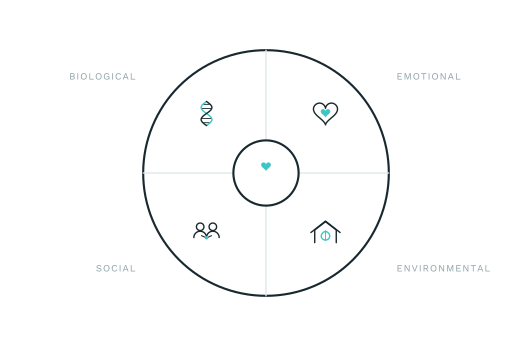








BSE² is the Care Map Method™ framework for understanding a person before making a care decision. It reads four domains in a fixed order: Biological · Social · Environmental · Emotional². Each domain holds part of the situation. The decision becomes clearer when they are read together rather than handled as separate checklists.
Emotional is squared because it carries what care planning often leaves unnamed: dignity, grief, identity, autonomy and purpose. These are not finishing touches added after practical needs are solved. They shape whether a person can accept support, trust an arrangement and remain recognizable to themselves within it.
Biological
The Biological domain covers the body and its routines. Depending on the person, it may include health, development, sleep, nutrition, mobility, medication information received from the care team and the physical demands of daily life.
This domain helps define what support must be able to carry. It also establishes the boundary between observation and diagnosis. Families can describe what they see. Clinicians and medical teams determine what is medically true. A Care Map™ keeps those sources distinct while making sure practical care reflects the information the family has been given.
Social
The Social domain covers the people around the person: family, friends, caregivers, school, work and community. It asks who is involved, who holds responsibility, where relationships are strong and where expectations conflict.
Care changes a social system. A new caregiver enters existing family dynamics. An adult child takes on work a parent once handled. A workplace benefit becomes part of an employee's private care network. Reading the social domain helps a decision account for these relationships instead of asking one new service to absorb every tension around it.
Environmental
The Environmental domain covers the setting and the practical conditions around care. It includes the home, schedule, transportation, logistics, money, technology and the resources available to sustain an arrangement.
Environmental fit is often where a promising choice becomes workable or impossible. A provider may meet the person's needs but sit too far from the family support network. A caregiver may be well matched but unable to work within a changing schedule. A digital tool may organize tasks while creating a new burden of setup and oversight. The map names those constraints before they are mistaken for personal failure.
Emotional²
The Emotional² domain covers dignity, grief, identity, autonomy and purpose. It asks what the change means to the person, what they fear losing, what choices remain theirs and what makes daily life feel worth participating in.
A care decision can be sound in every visible way and still fail here. Help can feel like a verdict on competence. A safer setting can separate someone from the roles and relationships that give life meaning. A parent returning to work can feel grief even when the childcare arrangement is strong. Emotional² gives those realities the weight they require.
This domain does not turn consultation into psychotherapy. It ensures that educational and strategic care planning does not erase the inner life of the person at its center.
Reading the Domains Together
The value of BSE² is in the interaction among the domains. A refusal may appear emotional and begin with a physical routine. A scheduling conflict may appear environmental and expose an unspoken family role. A technically appropriate match may fail because it threatens autonomy or asks too much of the support network.
For a family, reading the domains together creates a fuller map before options are discussed. For an employer, health tech team or care platform, it offers a consistent way to shape intake, content, matching and training around the whole person. The framework supports MAP within MAP → MATCH → MERGE → MANAGE™ without replacing human judgment.
BSE² changes a decision by changing what the decision maker is able to see. The four domains create one connected view of the person, the people around them and the conditions in which care has to work.
Care Map consulting and advisory work is educational and strategic. It is not diagnosis or treatment and does not create a therapist–client relationship.